BOOKING & REVENUE
Three messages that fill a cancelled slot
Late cancellations cost salons 150–250k SEK per year. Three SMS types that save your weeks.
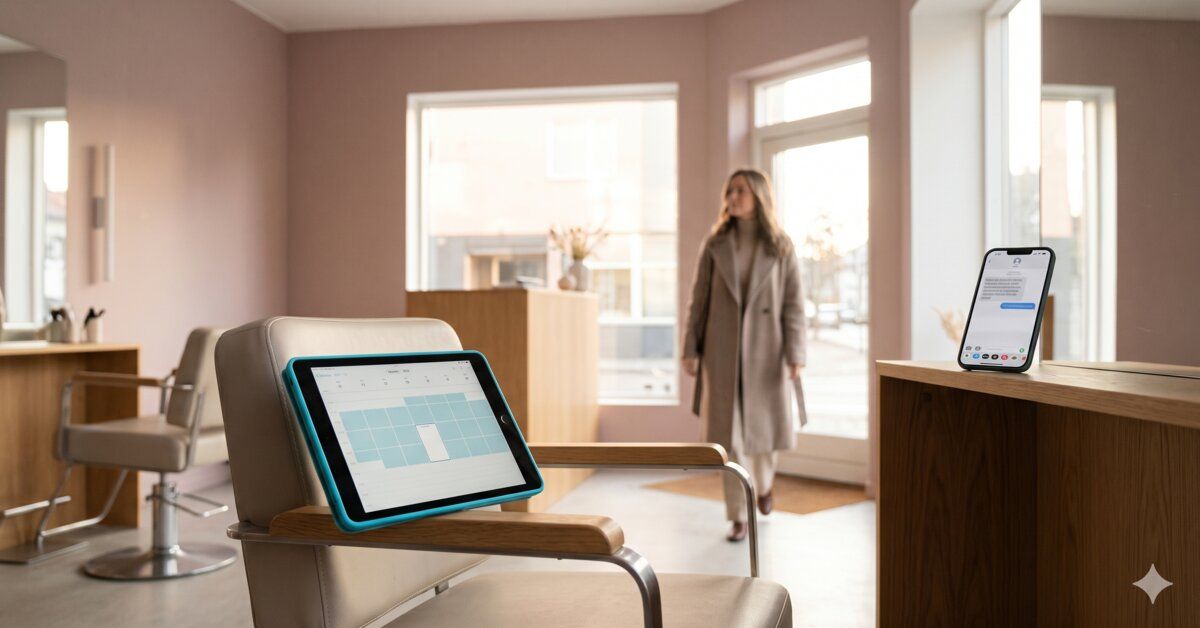
An SMS lands at 2.07pm. "Hi! I unfortunately have to cancel tomorrow at 11am, something came up. Sorry."
You read it on a break between two clients. You reply politely. You open the booking schedule and look at the gap that was just created. An hour and fifteen minutes. Cut and colour. Close to two thousand kronor in lost revenue – just like that.
And there's no one on the waiting list. Because you don't have a waiting list.
It's the industry's most expensive problem. And it's more solvable than most people think.
Why cancellations aren't a one-off mistake
In the hair and beauty industry, the share of short-notice cancellations – less than 24 hours – averages 8–12% of all bookings. For a salon with 40 bookings a week, that's 3–5 cancelled slots. Over a year, that's 150–250 holes in the schedule.
If each slot is worth an average of 1,000 kronor, the annual cost lands at 150,000–250,000 kronor – for a small salon. For a larger one with multiple chairs, it doubles.
That is money that goes straight out the window. And what's most surprising is that most salon owners accept it as a law of nature, like the weather. It isn't. It's just a communication problem that never got solved.
Why "calling around" isn't enough
The classic solution is to call or text around to customers who might be able to step in. It rarely works, and not because customers are unwilling. It's because you don't have the time.
When a cancellation comes in at 2.07pm for the next day at 11am, you have maybe 20 hours to fill the slot. Sounds like a lot – but you're not at the office for 20 hours. You're cutting. You have other clients.
To fill the gap you need three things at once: the right customers (the ones who'd actually want to come in), the right channel (where they read messages within minutes), and the right message (that doesn't feel desperate but attractive).
Three messages that actually work
Below are three message types that consistently fill cancelled slots in under an hour in the hair and beauty industry.
Message one – the close customer who hasn't been in for a while. "Hi Anna! Got an unexpected slot tomorrow at 11am. We haven't seen you in a while – if you'd like, you're welcome in for a cut. Call or reply and I'll book you. /Linda" Targeted at a specific customer. Personal. No desperation. High response rate.
Message two – the segment that often books exactly this. "Hi! We've got an 11am slot free tomorrow for colour + cut. First come, first served. Click here to book: [link]" Sent only to the 30–50 customers in the database who have previously done exactly that treatment. A mass send, but segmented so it feels relevant.
Message three – the micro-offer for filling the hard-to-fill. "Short notice: tomorrow 11am free. 150 kr off if someone can take it before tonight." Used sparingly, only for genuinely hard-to-fill slots.
Studio Idana uses segmentation to reach the right customers at exactly the right time, filling what would otherwise be dead time.
Why it's SMS and not email
The open rate for SMS sits at 98%, and 90% of all SMS are read within three minutes. Email sits at around 20% open, and most are read – if they are read at all – the next day.
When you have 20 hours or less, SMS is the only channel that has time.
Summary
Late cancellations cost the salon industry six figures per chair per year, yet almost no one treats it as a solvable problem. It is. Three different types of SMS – to the right customers, through the right channel, with the right message – can fill most of the gaps before the day is over.
See how salons fill cancelled slots without the stress. Explore PayAtt's SMS templates →